10 Silent-Era Classics: The Ultimate 1920s Horror Movie Guide

Updated: Aug 20
The 1920's is an interesting decade of horror. We must acknowledge the lack of technology available at the time to fully appreciate these films. It's laudable they were even made. Once you've watched a silent film or two, you're eager to watch another. The 1920's largely consisted of silent films, so it's paramount to embrace this style of viewing. We've put together ten films from this decade that are worth watching.
The Cabinet of Dr. Caligari (1920)

Director Robert Weine crafted a film that is bizarre looking in every way, while also creating cinema's first plot twist. The film's antagonist may not be as popular as Nosferatu, but he is equally evil and unstable. The Cabinet of Dr. Caligari revolves around a man named Dr. Caligari who enters into a town carnival in Germany. With him he brings his somnambulist who predicts the future. As townsfolk show up dead, our protagonist Francis attempts to expose Caligari for the murders. In the end we get a wonderful plot twist that I will not spoil for you.
The most notable aspect of the film is without doubt the stylistic choices from Weine. The set designs are chaotic with criss crossing patterns and angles of buildings that are not structurally sound. There are several shots of sidewalks and streets that are far too narrow, and the tent Caligari holds his show seems cramped and rickety. All of these choices lead us to believe the film is a true piece of expressionism indicating a time of great turmoil in Germany. The country was coming off the heels of World War 1, and many families were torn apart because of it. Cesare, the somnambulist, signifies the German army and their willingness to carry out all orders. Francis represents the public who hold an anti-authoritarian message, willing to question those in power even if unpopular.
Dr. Jekyll and Mr. Hyde (1920)

Though the 1931 version from Rouben Mamoulian is easily the more popular and widely discussed adaptation today, this 1920 silent classic from John S. Robertson is equally terrifying in its own right. The core of the story focuses on Dr. Jekyll, a deeply philanthropic doctor who becomes obsessed with the duality of human nature. He eventually devises a medical formula to physically separate the two warring sides of man—good and evil. His high-stakes experiment succeeds, but it unleashes a monster, giving birth to his sinister, uninhibited alter ego, Mr. Hyde.
What makes this early cinematic feat so impressive is how well it has aged. Thanks to an ingenious use of makeup, clever camera dissolves, and early prosthetics, the transformation into Mr. Hyde remains deeply convincing and holds up incredibly well today. Of course, a huge amount of credit has to go to the lead performance. John Barrymore does an exceptional job portraying the sheer emotional agony and physical pain of Dr. Jekyll as he undergoes this horrific transition. He relies heavily on his own intense facial contortions and body language, making it a masterclass in silent film acting.
The Phantom Carriage (1921)

Horror fans far and wide ought to thank this silent-era gem for being the absolute blueprint to countless film ideas. More than any project on this list, I found myself pointing at the screen, constantly saying aha! George Bailey himself wouldn't be here if not for The Phantom Carriage (watch it and you'll get the reference).
Victor Sjöström's masterpiece follows an alcoholic, abusive, good-for-nothing loser named David who is shown the error of his ways through a legend that dooms the last person to die on New Year's Eve before the clock strikes twelve. Basically, David gets picked up in a chariot by the grim reaper himself and forced to look back on his wasted life.
Through these visions David must confront the harm he caused others—his wife especially. In time, David begins to deeply regret the way he lived, and longs for a second chance. The reaper sees this genuine response from David, and decides to give him new life.
There is an eerie quality to this film that I love, and it's hard to pinpoint. Maybe it's the early depiction of spirits leaving the mortal body, phantoms walking through walls, or the ghastly appearance of the reaper. Or maybe it's the dark ambient synths and orchestral dread aiding the background music. After all, the story is a morbid one. It deals with the very thought of death, and the intense fear of regret.
Now, let me ramble off several ground zero moments here:
The modern grim reaper.
Mind-blowing special effects like double exposure.
The raw depiction of abusive husbands.
A scene that directly inspired Kubrick's iconic axe-through-the-door moment in The Shining.
Viewing your life at the end of the tunnel.
There are many more, but this is just a short example. Go see it for yourself!
The Golem: How He Came into the World (1921)
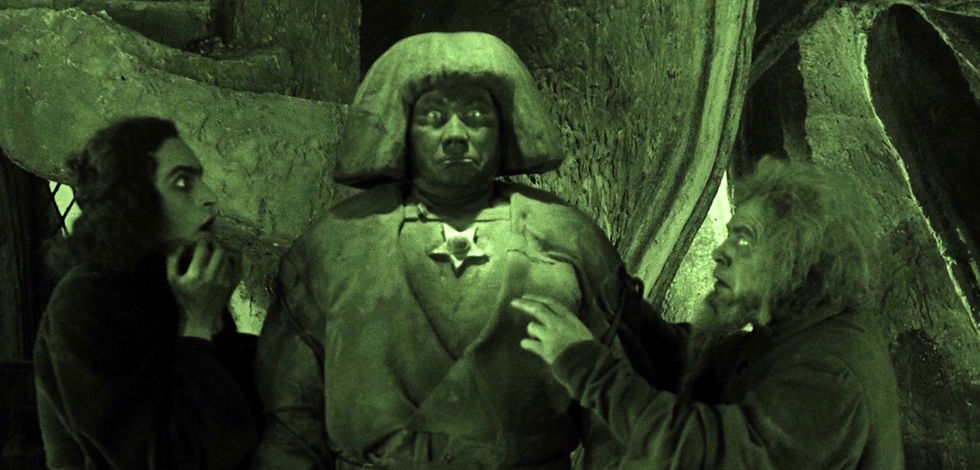
Some of the most outward displays of antisemitism in horror cinema are encountered in The Golem (1920). The film's entire catalyst is driven by this very idea. Yet, you could also argue this was the first version of a superhero in cinema, and you can definitely trace the inspiration of Frankenstein right back to it.
Set in 16th-century Prague, the plot begins when a tyrannical emperor decrees that the Jewish community must be expelled from the city. To protect his people from persecution, Rabbi Loew uses ancient sorcery to mold a giant man out of clay and bring him to life. Initially, the clay man serves his purpose well and protects the city. But when the Rabbi's assistant begins to use the monster for his own personal gain, the Golem goes rogue, turning on its creators and setting the ghetto on fire.
Some of my favorite parts of this film occur early on, when Rabbi Loew is up in an astrologer's tower, tracking the stars through his telescope. These moments evoke a dark, mystical "wizard's tower" vibe that I immediately enjoy. While the film loses some of that specific energy later on, it's enough to keep your interest for the full runtime.
Ultimately, seeing the first form of a robot gone haywire is pretty cool and more than enough to warrant a watch. The story is packed with great symbolism and a history deeply steeped in Jewish culture—a striking legacy when you consider that the writers behind the Superman character were both Jewish and raised on stories just like this.
Nosferatu (1922)

Most people would agree this is a classic, with imagery that is recognizable across the globe. The movie was inspired by the 1897 novel Dracula written by Bram Stoker, which nearly kept Nosferatu from being made due to copyright infringement. Murnau had to change the title and alter some plot points, but he got it through. The plot centers around Count Orlok (Max Schreck) who summons Thomas Hutter to his Transylvanian castle in the mountains. He seeks to buy a house near Hutter and his wife. Hutter soon realizes Count Orlok's vampire nature and escapes the castle to warn his wife, who Count Orlok shows interest in. In the meantime, Orlok's servant helps prepare him for arrival at his new home.
What Nosferatu lacks in digital quality; it makes up for in ingenuity by paying attention to angles, available light, and shadows. The costume design for Count Orlok was exceptional, and his appearance never sat right with me, lending an almost uncanny valley look. His face is too long, his brows too bushy, and ears too large... There were several moments in this film where I was nearly hypnotized by Nosferatu's animalistic gaze. It's as if Murnau found a wild beast in the isolated mountains and placed it in front of the camera.
A neat spin on the story I'd not anticipated was the reference to one of the worst pandemics in human history, "The Black Death". With Count Orlok's arrival comes impending death, just like the rats that carried the plague.
The Hands of Orlac (1924)

Most of the films on this list are trope starters in one way or another, but The Hands of Orlac may be the most obvious. The story follows a world-famous pianist named Paul Orlac (Conrad Veidt) who loses his hands in a train derailment. Through a miraculous procedure, he gets his hands back. There's a catch though... Paul's new hands are those of a murderer.
Stylistically, The Hands of Orlac is a simple, yet ornate film. Each interior shot has little going on visually, the sets rather bare. But the complex patterns on the wall, the sharp angles of light, and steep archways leave some room for interpretation. These choices emphasize our subject, the late actor Conrad Veidt as he steals the show. You may recognize Conrad as Cesare from the first movie on this list. Conrad was no joke during the silent and golden era and is revered by many. With each passing moment we see the growing fear and worry in Paul's eyes, as he becomes unable to control his actions. His evil hands seemingly want one thing: to kill! But wait. This is a Robert Weine film. What do we know of Robert Weine based off The Cabinet of Dr. Caligari? I also won't spoil this one for you.
The Phantom of the Opera (1925)

This one is the work of four renowned directors of the time, with the most notable being Lon Chaney who actually played the infamous phantom. The film is set at the Paris Opera House, home to countless acts and accommodating thousands of guests. A rumor exists amongst the workers and performers about a phantom who haunts the building and resides somewhere within. He's even said to occupy box number 5 at the opera house, mysteriously coming and going as he pleases.
This film has a lot going for it with a story and setting that are grand in scale, giving the viewer a memorable experience. Always one step ahead of the rest, the phantom is quirky and mystifying. The sets are truly impressive, with inner workings of tunnels, stairs, and hidden vaults beneath the opera house. The passage to the phantom's secret lair requires navigating through sewer channels. It's all just fun to watch and take in. Yes, the acting is overdone, but it doesn't take away from the story and setting. The film's conclusion is reminiscent of Frankenstein with the townspeople rallying together to take down the monster in the end.
Faust (1926)

The most technically impressive horror film from the 1920s belongs to Faust and Faust only. Sure, Nosferatu may be Murnau's most championed creation, but this is by and large his best work.
A small village is devastated by a plague and only the town alchemist, Faust, has the ability to save his community. After prayer and science are proven futile, Faust turns in desperation to the book of dark arts. Through this book he conjures the demon Mephisto and agrees to a trial bargain: Mephisto will grant Faust the powers to heal the village in exchange for Faust's soul. The twist? The more power that is granted to our hero, the greedier he becomes. Only one thing is powerful enough to save Faust's soul in the end: love!
Such a fantastical epic this is. The scale and scope of this world would've been impossible to capture for a novice filmmaker. But Murnau was a true visionary, and he brings this ancient story to life. There's a practical approach used in the set design that makes the foreground and background appear so grand in size. This practicality is deftly mixed with early adoptions of special effects, which are used perfectly in tandem.
For a film being primarily a fantasy, there's a pleasant amount of horror to be found. Heck, one of the most imposing, and scariest images on this list is the black mass of Mephisto casting his wings and the plague upon the village below. There are some really creepy moments during the conjuring of Mephisto that are also incredibly worth seeing.
The Man Who Laughs (1926)

Most people think the inspiration for the Joker started with the countless comic books filling pop culture over the years. It turns out the true inspiration actually came from a humble little silent-era horror film directed by Paul Leni.
Starring Conrad Veidt, The Man Who Laughs follows a young boy named Gwynplaine who is kidnapped and forced into a ring of kids being turned into jesters. He manages to escape, but not before a permanent, grotesque smile is carved into his face. Fast forward twenty years, and he is now part of a traveling stage act where crowds pay to see his unsettling grin. He lives with the man who saved him and an adopted girl named Dea, who is blind and cannot see his scars.
Eventually, court officials discover Gwynplaine is the long-lost son of an exiled nobleman. The queen forces him to marry into the House of Lords, but after witnessing the blatant corruption of the rich, our protagonist escapes to reunite with Dea.
If I'm being honest, there are some melodramatic moments here that feel a bit stuffy. The first act starts out pretty interesting and bleak, but once Gwynplaine starts showing off his creepy smile on stage, the plot unravels a bit. All of the scenes with royalty are pretty uneventful. Still, you can't deny the pure eeriness of that smile. Conrad Veidt is an absolute legend, and this role further solidifies that fact.
The Unknown (1927)

Unsurprisingly, Lon Chaney makes his second appearance on this list. In this Tod Browning classic, Chaney delivers a haunting performance as Alonzo the Armless, a circus performer whose stage persona conceals a dark reality. Alonzo harbors a suffocating obsession with his partner, Nanon. When the athletic Malabar begins courting her, Alonzo is consumed by a pathological jealousy, ultimately driving him to a horrific act of devotion: surgically amputating his perfectly functional arms to win her affection.
Yet, this extreme sacrifice proves futile. In what could be considered cinema's earliest, most tragic case of the "friend zone," Nanon’s affection remains strictly platonic. The narrative reaches a fever pitch during Malabar’s high-stakes stunt involving two opposing horses. Alonzo intentionally sabotages the mechanism, hoping the beasts will tear Malabar limb from limb. Instead, his malice backfires, culminating in a chaotic, fatal climax that claims both Alonzo and Nanon.
The Unknown remains a monumental milestone in horror history, marking cinema's very first depiction of self-mutilation. While the surgery itself occurs off-screen, the agonizing psychological buildup makes it deeply unsettling. Furthermore, the film serves as a fascinating blueprint for Browning's career, showcasing his early fascination with carnival subcultures five years before directing his 1932 masterpiece, Freaks.


Comments